
One of the oldest homes in California‘s wine country has been brought to the market for the first time in more than a decade—having changed hands on only a few occasions since it was built for one of Sonoma County‘s most prominent “pioneering settlers.”
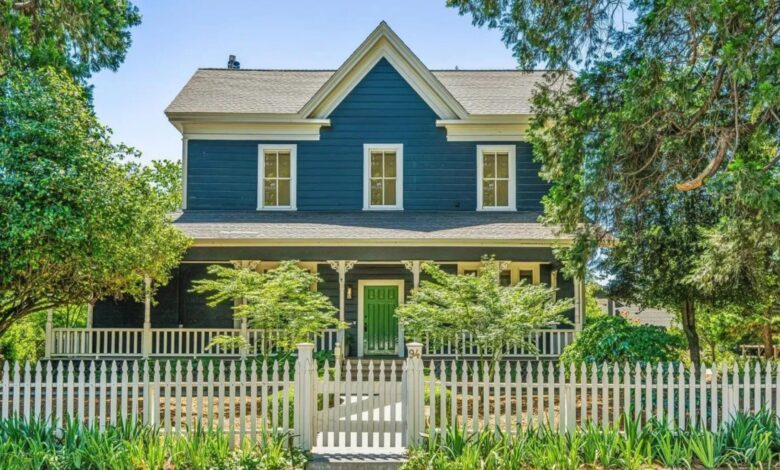
Built in 1868, the four-bedroom, two-bathroom Greek Revival home in Healdsburg is referred to as Hassett’s Ranch in honor of John D. Hassett, the man who commissioned it all those years ago, when it was seen as “one of the most prestigious homes of its era,” according to the listing.
Now on the market for $3.9 million, the dwelling is ready to embrace a new chapter, having been lovingly cared for by its current owners for more than 10 years.
“The fact that this is dating back to 1868 and is in wonderful condition is a testament to how wonderful the homes were built back then, and how well the stewards have maintained this,” City Real Estate agent Rachel Hooper, who is co-listing the home with Drew Raher, explained.
“It’s a really special home, unlike anything else.”
In many ways, the house is a tale of two histories; though it is deeply connected to Healdsburg’s rich winemaking heritage, Hassett was actually not a winemaker. Instead, he established Healdsburg’s first flour and saw mills and also launched the first local bank, helping the local economy to boom.
Much like Hassett, the home was also one of the building blocks of what is now a thriving community—in fact, the only Healdsburg house still standing that is older than this dwelling is the Hassett Cabin, which was built in 1853, having also been commissioned by Hassett.
Other than the Camellia Inn, which was built in 1869 and was formerly known as the Ransom Powell House, the next homes in the community didn’t pop up until the 1870s.
With four bedrooms and two baths, this could easily suit a family but might also entice as a second home, with Hooper revealing that she and Raher have seen several inquiries from San Franciscans who are seeking a weekend or vacation retreat for their families.
“We’re seeing a lot of interest from San Francisco buyers as second homes,” says Hooper. “People are looking at this as a family compound or a space for family to gather.”
Owners of homes in more rural areas of Healdsburg are also expressing interest, says Raher, due to concerns about wildfires.
When the sellers bought the home in 2015, from a family that held on to it for 20 years, they had initially planned to use it as a second home, before deciding to move into the residence full time.
At that point, they embarked on a large number of updates that included adding new tankless water heaters and A/C, as well as modernizing the baths.
Previous owners added a pool and also did some work on the foundation when they converted it from a duplex back to a single-family home. A putting green has also since been added, turning this property into a perfect spot for entertaining.
The property also offers another rare amenity in Healdsburg: land. Set on just under half an acre, it offers more than most dwellings in the area—and its residents over the years have taken full advantage of that feature, turning the parcel into a lush oasis.
Mature trees are in abundance, including dogwoods, cedar, maple, palm and citrus, joining established flower gardens.
“Standing on the front porch, you’re looking at trees and you have this sense of being farther out, in the country, but you’re moments from the Foss Creek Pathway, which takes you to the farmers market, incredible food, and the town plaza,” explains Hooper.
What’s more, while the home is located in a historic district, it’s not designated as historic. This means the buyers can continue updating with fewer restrictions.
“For people that want to do renovations, there’s a little bit more flexibility,” says Raher. “A lot of people we’ve had come through had the idea to push out the back of the house to add more space.”
Another area to expand lies in the 1,000-square-foot detached carriage house, with its 15-foot ceilings and existing electricity and water service. An additional 900 square feet of attic space in that carriage house could be converted into living space.
“We’ve done some preliminary renderings to give people inspiration,” says Hooper. “We’ve seen a lot of people in the area, and around the Bay Area, transform garage space into ADUs. It’s always nice to have guests visit but not necessarily [stay] in your space.”
Turning it into an Airbnb is another option.
Given the home’s long provenance, there have been opportunities to meet past residents, or those connected to them.
“On Father’s Day, one of the descendants of John Hassett brought her father [to an open house],” says Hooper. “We’ve come across a lot of people who have connections to the house.”
Get real estate news in your inbox
Source link