

The government’s
latest
proposed revamp of asylum laws reminds us that Labour
have not abandoned their approach of using right wing populist
policies and rhetoric to appeal to Reform voters. Let’s call this
the Blue Labour electoral strategy. The introduction of some new safe
routes is welcome, but how effective or limited these will be remains
open. What has gone with this is a raft of proposals to make asylum
seekers feel less welcome and generally make their lives even harder.
The reason for this
is that Labour’s key political advisers, led by Morgan McSweeney, steering
the politics of the government (because we have a remarkably
non-political Prime Minister) favour a Blue Labour ideology, which is
socially conservative together with being leftish on economic issues.
Ever since they were elected, I and almost everyone else I read has
been despairing at Labour seemingly bending over backwards to ape
reform on key social issues. Not just because we don’t like the
rhetoric and policies, but because we think it is counterproductive
in electoral terms. It will reduce the Labour vote and bolster right
wing populism. As I
suggested last week, ruling out rejoining the EU’s
customs union or single market is part of the same approach.
The first Blue
Labour electoral fallacy is that what worked in opposition will work
in government. I
have agreed that this strategy makes sense in
opposition, because the voters that make up Labour’s social liberal
base would still vote for them where it mattered as the priority was
to get the Conservatives out. It therefore helped Labour in oppositon
to say things that might not put off more socially conservative
voters from either voting Labour, or at least not voting Conservative
to keep Labour out.
But I have also
consistently argued that this strategy doesn’t work when Labour
achieves power. (In December 24 I called it the politics of stupid.) That has been obvious in the polls for some time.
Most of those socially conservative voters will not be happy with the
record of whatever government is in power on issues like immigration
and asylum, pretty well irrespective of what happens to immigration
or asylum numbers. As a result, even if they didn’t vote against
Labour in 2024, they almost certainly will in 2029. The media will do
their bit to ensure that happens. In contrast, social liberals who
ignored what Labour said in opposition when voting Labour in 2024
would find it much more difficult to ignore actions when Labour is in
government.
Yet Labour have
continued to ape Reform and the Conservatives on issues like
immigration, despite the polls. Apart from the apparent success of this policy in 2024,
a second electoral fallacy that they use to justify their strategy is
that voters in Labour’s key marginal constituencies are very
different from those in Labour’s safe seats. The belief is that
Labour 2024 voters in marginals are socially conservative, whereas
Labour’s safe seats are where all Labour’s social liberals are.
This idea is
encouraged by media reporting, with for example VoxPops in Labour’s
so called ‘Red Wall’ often featuring elderly voters worrying
about immigration. We are very used to reading pieces about the
‘typical voter’ in these kinds of seats, and how different they
are supposed to be from other voters in cities like London, for
example. So when it’s pointed out that polls show Labour at crisis
levels after pursuing the McSweeney strategy for a year in
government, and that they are losing far more voters to the Greens,
Liberal Democrats or nationalists than to Reform and the
Conservatives, we are told that it’s not voter shares that matter,
but just the voters in the socially conservative Labour marginals.
Like many myths, there is an element of truth in all this. But it is a
truth that has been blown out of all proportion.
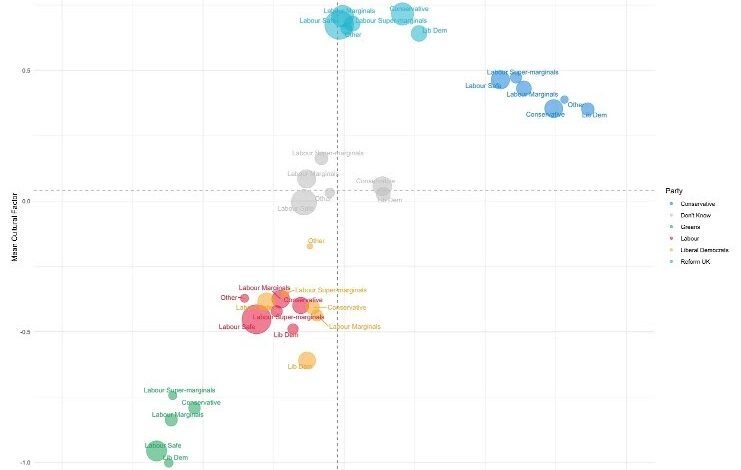
The evidence for
this is brilliantly provided in a substack
by Ben Ansell, Professor of Comparative Democratic Institutions at
Nuffield College, Oxford. His key diagram is reproduced below. It
plots voters by the party they support in the British Election Study
data from May, 2025, using the usual colours. In addition it splits
those voters up into those who are in Labour marginals, Labour super
marginals and safe Labour seats. Where voters are placed on the
diagram depends on their economic views (left versus right on the
horizontal axis) and social views (conservative versus liberal) on
the vertical axis.

Voters are where we
expect them to be. Green voters are very left and socially liberal,
Labour and LibDem voters leftish and socially liberalish,
Conservative voters very right wing and quite socially conservative,
and Reform voters very socially conservative and in the middle on
economic issues. Don’t know voters are on average bang in the
centre on both axes.
Now if we look at
how the Labour vote breaks down by seat type, then indeed in
marginals Labour voters are slightly more right wing and socially
conservative than in safe Labour seats. (If you cannot see this and
cannot zoom in, see Ben’s post that does the zooming for you.) But
the differences are small. Crucially, Labour voters in marginal
seats are far more like other Labour voters than they are like Reform
voters. This is what Ben Ansell calls Blue Labour’s ecological
fallacy,
It’s a fallacy
because the reality is that if a Labour government sounds and acts
like a slightly milder version of a Reform government, this is going
to put off nearly all Labour voters, whatever type of seat they are
voting in. It will put off most Labour voters in Labour marginals.
It may make sense for Labour to tack a little towards the centre on
both social and economic issues to attract back don’t knows, but it
does not make sense for Labour to position themselves just below
Reform voters on this diagram, because they will be in danger of
losing most of their votes in every constituency that voted Labour in
2024.
Placing your party
just towards the centre compared to your rival party or
parties makes sense when your rivals take very non-centrist positions
and there are no other parties picking up votes in the large area
that is left in voter preference space (e.g. you have a two party
system), or when those voters whose preferences you are leaving
behind are going to vote for you anyway because they hate your rivals
so much. But we are no longer in a two party system. If Labour
ignores the views of most of its 2024 voters, many will stop voting
Labour. Talking about Labour marginals doesn’t change that basic
fact.
A third Blue Labour
electoral fallacy is that their strategy will work in the end,
because social liberals would rather have a Blue Labour government
than a Reform one. There are three fatal problems with this argument.
First, all the evidence we have suggests that tactical voting, while
widespread, is far from dominant. For every voter that will vote
tactically there is another that will not. Second, this idea that
social liberals will return to Labour when it matters completely
ignores the dynamics of what will happen before any general election.
As I, and many more
qualified like Rob Ford who is co-author of the The
British General Election of 2024,
have been pointing out is Labour’s current strategy will empower
other parties that are socially liberal in council elections. That
alone could be enough to remove the Prime Minister! But even if it
doesn’t, it gives those socially liberal parties a claim that they,
rather than Labour, are most likely to win various parliamentary
seats. So when it comes to the general election, tactical voting will
either not work because of competing claims, or result in Labour
losing many seats in its real heartlands, which are the big cities of
the UK. A third problem is that many social liberals might vote against Labour in the hope of getting a coalition government involving socially liberal parties.
I put Labour’s
attachment to this failed strategy and refusal to change down to Blue
Labour ideology. But as the above illustrates it is a suicidal attachment to ideology because it ignores all the political facts. For one more example on asylum there is a ridiculous proposition that
goes with the cruelty and inhumanity that Labour is showing. The
proposition is that cruel policies are necessary to allow both
control (of small boats) and to somehow make voters want to be
tolerant and welcoming again. There is little evidence for the
former, but the second shows an incredible political naivety about
right wing populism.
As long as there are
significant small boat crossings then right wing populists will
make this an issue and the media will ensure it tops the news agenda.
For that reason alone, immigration and asylum will stay as a major
‘voter concern’ whatever Labour home secretaries do or say. By
constantly upping the cruelty and inhumanity, ironically Labour is
helping to ensure asylum seekers and small boats remain headline
news, and encourags voters to believe this is a major national concern. [1]
But there is another
element to Labour’s refusal to abandon the Blue Labour strategy
besides this ideology, and that is excessive caution in doing
anything much to alter the current status quo. The status quo is what
the last government left us with, coupled with a media that is either
flying the flag for right wing populists or is desperate to appease
them. So political
appointments by the last government to bend institutions to their
will, like the BBC or the EHRC, are still in place.
Donald Trump, as part of his policy of suing (on ridiculous grounds)
any media organisation that is not already deferential to him is now
intending to sue the BBC, and yet the government does nothing about X
and even refuses to diversify from this social media platform just in
case that might offend someone. It looks like the Budget will follow
similar lines of timidity.
As I have said
before, we have a government of small change. Whatever you think
about gradualism in general, at the moment it is the last thing most people want. They are desperate for big change, whether it is on
living standards (see Brexit) or public services (see my
analysis here). People may currently be too impatient,
but I think it’s partly because they cannot see even the prospect
of big changes from this government. If our current ministers think
that what they are doing now will lead to big changes in a few years
time then unfortunately I think they are also deluded. [2]
[1] Typically voters don’t see these issues as a concern in their own local area
[2] All this
indicates that we are in the unfortunate position of having a
government that is largely incompetent both in policy and political
terms, after suffering 14 years of incompetent policy. As this
incompetence doesn’t just currently reside among Labour ministers
in parliament but extends to the Conservative and Reform MPs, it
raises the more general question explored
by Chris Dillow of whether our political and media
system has over the last few decades begun rewarding the incompetent
and discouraging the competent.
Source link


