
Labour, a supply side explanation for the rise of populism, and the growing acceptability of xenophobic discourse in the UK

I never cease to be
amazed at how bad Labour politicians are at politics. It may seem
arrogant for an economist to say that, but it’s not just my view,
but the view of so many of the political scientists or journalists
that I follow. Take, for example, the recent fall in net migration
numbers, from a high point of nearly a million under the Tories to
just over 200,000 last summer. That is a huge fall, and what Labour
should be saying first and foremost that it is a huge fall, and
secondly warning that this kind of fall will certainly not be
repeated and may not be sustained. Yet what
did the Prime Minister say? “It’s a step in the
right direction.”
The Home Secretary
has
also said she wants to go further. In what should have
been a huge political boost for Labour, they have created a future
hostage to fortune by implying that 200,000 is still too high, and
that they would like numbers to fall even more. They might get lucky
of course, but equally they might not, and governments have very
little ability to control immigration numbers without damaging the
economy. Some have already noted that the government’s desire for
lower numbers is inconsistent with the OBR projections in the Budget
forecasts, and that lower immigration numbers than forecast would
worsen the public finances. So the government has managed to snatch
future defeat from the jaws of victory.
I am bored writing
about and I’m sure you are bored reading about the specifics of why
Labour’s approach to immigration and similar social or cultural
issues is so wrong-headed and will cost Labour a lot of electoral
support. In this post I want to go further, and suggest that Labour’s
approach might be at least in part responsible for a more widespread shift in the
Overton window that has allowed racist, xenophobic and socially
divisive discourse to become increasingly acceptable.
To do this I need to
talk about demand and supply theories of the rise in right wing
populism. Here demand refers to voters and their preferences. There
are many of these demand side theories, which can in turn be
subdivided in cultural and economic. For example, on the cultural
side rapid social liberalisation is likely to produce a backlash
among socially conservative voters, who will in turn be attracted by
populist politicians pushing culture war issues. On the economic side
it is argued rapid globalisation without a strong regional policy can
lead to sections of society being left behind, and they will be
attracted by populists attacking the ruling elite.
In contrast, supply
side explanations look at why politicians and other key figures on
the right and centre
might increasingly resort to populist rhetoric and policies, and how
this may in turn encourage other far right parties or groups. This is
a theme I have explored a
number of times in my posts. In particular the idea I
have discussed is that right wing politicians, still wedded to
neoliberal policies, find that these policies and the inequality they
create are increasingly out of favour with the electorate. As a
result they shift their campaigning on to social issues, such as
immigration, in an effort to win elections. To this can be added a
similar move by wealthy media barons and very rich donors, concerned
that a backlash against neoliberalism might threaten their own wealth
and power.
In this I have
obviously been influenced by the New Labour period, where the
Conservatives increasingly used immigration as its weapon of choice
in attacking the government. Something very similar happened in the
United States, where culture war issues moved to the fore in the
contest between Republicans and Democrats. It is true that in the US
immigration as an issue was less prevalent at first, but arguably
this was because race was at least a subtext in a number of policy
areas.
How could supply
side factors account for the rise in right wing populism? An argument
might go as follows. There will always be a significant section of society that holds pretty socially conservative and even racist
views. As a result, political parties will emerge that cater to those
views. In principle, those parties could achieve significant levels
of public support (20-30%, say).
Whether they do or
not depends on the attitude of the mainstream political parties to
strong socially conservative or racist views. If the mainstream shun
those parties representing those views and associated policies (as
they used to do in the UK), by in particular labelling
them as racist and by supporting bi-partisan anti-racism policies,
then political support for those parties will be held in check. An
electoral set up that favours two dominant parties and which makes it
hard for minority parties to get representation obviously helps in
this.
Conversely that
share can be magnified if the right wing mainstream party attempts to
attract these same voters. This is not just because by doing so they
emphasise those issues and make discussion of them respectable, but
also because these issues are the populists’ bread and butter. The
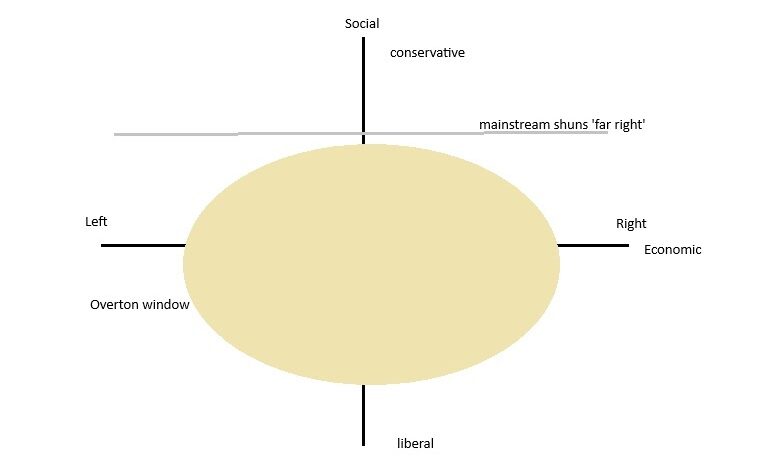
diagram below illustrates what I mean.
If the mainstream
shuns policies and discussion that is potentially or obviously
racist, that squeezes the Overton window of mainstream discourse so
it excludes strong socially conservative views. If instead that
barrier is removed, then the window can become enlarged in a socially
conservative direction. If in addition the mainstream right wing
parties focus on trying to attract socially conservative voters, that
can shift the Overton window even further north.

Now I personally
don’t believe for a moment that this supply side model is the
complete story of the rise in right wing populism. Demand side
factors are clearly important. For example times of economic
hardship, including periods of austerity, help lead to
dissatisfaction with mainstream parties and that helps populists. But
I do think supply side explanations are important. The supply side
model shows how the attitudes of the politicians of the mainstream
parties, and their backers in the media and among the wealthy, can
play a crucial role in either suppressing or amplifying support for
right wing populists. In the UK, the Conservative party in terms of
policy and rhetoric have done this to such an extent that to all
intents and purposes they have become a right wing populist party.
Which brings me to
the Labour party and its treatment of the issues that form the
bedrock of right wing populist support, like immigration and asylum.
It often appears as if Labour treat these issues as emerging only
from demand side influences, and in particular from the natural
racism and xenophobia of the electorate. Their idea is that if they
just move to satisfy this demand, then they neutralise immigration or
asylum as an issue. It is like a brand leader that is losing market
share to an incumbent because the incumbent has tweaked the product
in a way customers like. The obvious response is for the brand leader
to add that tweak to their product, taking away the incumbent’s
product’s unique appeal.
This analogy is a
terrible one, because the preferences of socially conservative voters
are not specified in this kind of detail. People who vote for Reform,
or the AfD, do not have detailed preferences over, say, the process
by which immigrants can become citizens. As a result, all that will
happen if a mainstream, non-populist party makes the immigration or
asylum process ‘tougher’, is that populist parties will shift the
goal posts and demand something tougher still. This is how the supply side model of populism works. Of course right wing populist parties will do this, because the whole basis of their support is to be ‘tougher’ on immigration and asylum than the government.
This is exactly
what has happened in the UK. Populist rhetoric has moved away from talking about immigrants in general and towards the demonisation of particular
ethnic or religious groups, and away from a concern about current
immigration numbers towards demands for deportation of legal
migrants. Associating immigrants and asylum seekers with crime is part of that pattern.
Of course populists
do run a risk with such escalation, not so much in compromising their
core support but in uniting social liberals against them. But that
risk can disappear when Labour is also moving to a much more
illiberal position. [1] Instead it represents an example of the
Overton window shifting towards social conservatism that I discussed
above, and it is what has happened in a big way in the UK over the
last year or so.
Why in the last few
years in the UK has it become acceptable to publish
articles in the press that invoke replacement theory,
and to routinely find politicians calling for the deportation of
asylum seekers and migrants irrespective of their legal status, along
with suggestions that Islam and other cultures are ‘not British’?
There is little evidence supporting ‘demand side’ explanations: UK voters haven’t suddenly become more xenophobic or racist.
Instead we need to look at ‘supply side’ explanations that focus
on the behaviour of mainstream politicians [2]. In particular, a
Labour government adopting very socially conservative policies on
immigration and asylum may have led to a response by right wing
populists that has shifted the Overton window to include more
xenophobic policies and discourse.
[1] If it was just
the Conservative party adopting more extremely socially conservative
positions, then Labour would benefit from social liberals being
radicalised to prevent right wing populists (Reform or the
Conservatives) winning. However because Labour has also adopted very
socially conservative policies on asylum and immigration, many social
liberals will turn to smaller political parties like the Liberal
Democrats and Greens, which of course is likely to benefit right wing
populists under a FPTP electoral system.
[2] There are other
supply side explanations which are also undoubtedly important, the two most obvious being the influence of
Trump, and Musk owning and influencing social media.
Source link


