

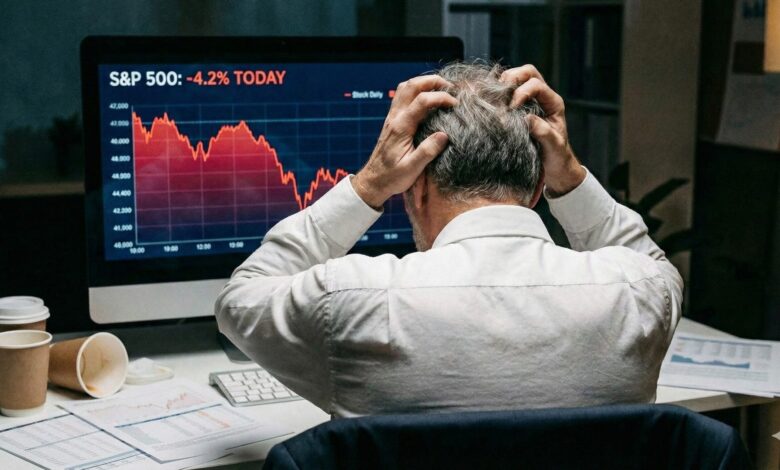
I bought my first stock more than 45 years ago. Since then, I’ve lived through the crash of 1987 (Black Monday), the dot-com bubble, the Great Recession, and the post-pandemic inflation spike.
Market cycles change, but one thing never does: human nature.
In my four decades of watching people try to build wealth, I have noticed that the biggest threat to your portfolio is rarely the Federal Reserve, the President, or the price of oil. It is the person staring back at you in the mirror.
We’re all hardwired to make bad financial decisions. We run from pain (selling when the market drops) and chase pleasure (buying when the market soars).
If you want to retire rich, you have to stop acting like a human and start acting like an investor. Here are five things to avoid.
1. Trying to time the market
This is the classic ego trap. You convince yourself you can get out before the crash and get back in before the rebound. Let me be clear: You can’t. Even the professionals can’t.
When you try to time the market, you have to be right twice. You have to sell at the top and buy at the bottom. If you miss by just a few days, you destroy your returns.
According to data from J.P. Morgan, if you stayed fully invested in the S&P 500 from 2005 to 2024, you earned an annualized return of roughly 10%. But if you tried to get cute and missed just the 10 best days in that 20-year period, your return drops to a bit over 6%.
Think about that. Missing two weeks of action over two decades cut your gains almost in half. The market’s biggest jumps often happen right after its biggest drops. If you are freaking out about the stock market and waiting for the “dust to settle,” you have already lost.
2. Paying high fees because you aren’t paying attention
In every other area of life, you get what you pay for. A Ferrari costs more than a Ford because it’s faster and presumably better made. You get something for your money. In investing, the opposite is often true. You can pay more for the same, or even worse, performance.
It’s just this simple: The more you pay in fees, the less you keep.
A 1% or 2% fee sounds small. It isn’t. It is a massive hole in your wealth bucket.
The SEC breaks down the math perfectly. Let’s say you invest $100,000 over 20 years with a 4% annual return. If you pay a 0.25% fee, your portfolio grows to about $208,000. If you pay a 1% fee, it only grows to $179,000.
That tiny percentage difference cost you nearly $30,000. Before you buy a mutual fund or hire an advisor, look at the expense ratio. If you are paying more than 0.50% for a standard fund, you are likely getting ripped off.
3. Thinking you can pick winning stocks
I’m a believer in buying individual stocks. The reason is simple: I’ve made a ton of money over the years doing it.
I’ve owned stock in Apple, Microsoft, Amazon, Nvidia, Google and other big winners for many years; in the case of Apple, 25 years. Of course, I’ve also had losers along the way, but I’ve definitely beaten the returns I would have gotten from a broad-based S&P Index fund or ETF.
But here’s the thing: I spent 10 years as an investment advisor and for decades I’ve spent several hours every weekday reading about this stuff. Every weeknight I watch a couple of CNBC shows for tips and information.
Sound like you? If it doesn’t, don’t buy individual stocks.
The data shows how statistically unlikely you are to beat the market over the long run by picking individual stocks. Consider this: over a 15-year period, nearly 90% of active large-cap fund managers fail to beat the S&P 500. And the managers of these actively-managed funds are professional investors, with institutional research and every bell and whistle at their fingertips.
If they can’t beat the index, what makes you think you can?
Unless you’re willing to invest a lot of time into research, stop trying to find the needle in the haystack and just buy the haystack.
As I cover in the golden rules of becoming a millionaire, a low-cost S&P 500 index fund will outperform the vast majority of stock pickers over a lifetime.
4. Letting your emotions drive the bus
When the market tanks, your brain screams “Sell!” to stop the pain. When your neighbor brags about making a killing in crypto, your brain screams “Buy!” to avoid missing out.
This emotional whiplash is expensive. The research firm Dalbar publishes an annual “Quantitative Analysis of Investor Behavior” (QAIB) report, and the results are always depressing.
In 2024, the S&P 500 returned a massive 25.02%. But the average equity fund investor? They only earned 16.54%.
That is a gap of nearly 8.5 percentage points. Why? Because investors panicked, sold at the wrong times, or chased trends that had already peaked. The market did its job. The investors didn’t.
Here’s something I’ve learned over the years. If you lay awake at night staring at the ceiling because you’re worried about your stocks, you have too much invested in stocks. That’s going to cause you to make mistakes.
5. Focusing on the rear-view mirror
There is a cognitive bias called “recency bias.” It means we give more weight to what happened recently than what happened further in the past.
If tech stocks soared last year, we dump all our money into tech. If bonds crashed, we sell all our bonds. We chase past performance, assuming it will continue forever. It rarely does.
Winners rotate. The hot sector of 2025 might be the dog of 2026. If you constantly chase what just worked, you are buying high and selling low—the exact opposite of how you build real wealth.
Stick to a diversified plan. Rebalance when things get out of whack. And for heaven’s sake, stop looking at your account balance every day.
Source link