

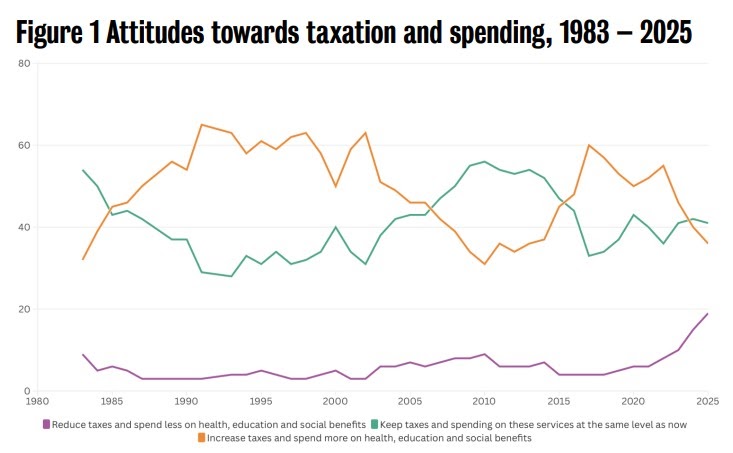
Does the recent
and unprecedented increase in the minority wanting a smaller state
reflect the non-indexation of tax thresholds? If it does, are social attitudes a
problem for those economists arguing to end the zero-rating of many
goods for VAT?
The National Centre
for Social Research produces an annual survey about British Social
Attitudes, and they have issued
a preliminary look at the survey conducted in the
Autumn of last year. One question that I have looked at a number of
times in previous years has concerned attitudes to taxes and public
spending. The latest results are both surprising and imteresting.

As I have regularly
noted, over the 40+ years of the survey the number of people saying
they wanted lower taxes and spending (a smaller state) has been
remarkably low at less than 10%. Remarkable, that is, given the
prominence that view gets in public discourse. But not any more. In
the last few years this proportion has grown significantly, and is
now at 19%.
Why is this? The
most obvious explanation is that taxes are going up, which is true.
But total taxes have risen before, and we haven’t seen this
response in public attitudes. Here is the share of total taxes in GDP
from the OBR’s database.

Taxes have risen
substantially since the pandemic, but they rose by almost twice as
much from 1993/4 to 2000/1, yet in the social attitudes survey there
is no rise in those wanting a smaller state over that period
comparable with recent movements..
One explanation for
this recent rapid increase in those wanting a smaller state would be
if people were much happier about the level of public services now
compared to the late 1990s. This isn’t plausible because both the
level of public service provision (measured by indicators like
waiting times for hospital appointments) and the level of spending on
public services is
clearly inferior to the period at the end of the last
Labour government, and is at least comparable if not worse than in
the late 1990s. The impact of the austerity period from 2010 onwards
has not been undone.
A more plausible
story is that those answering the survey are not thinking about total
taxes, but rather just taxes on income. Here is a chart from the
Resolution Foundation:

The noteworthy fact
this chart shows is that taxes on income have been falling for most
earners since 1980. [1] This hasn’t been true for the total tax
burden because taxes have been shifting from taxes on income to taxes
on consumption (e.g. VAT) or taxes on profits.
Very few survey
respondents will be aware of the total tax burden they face. What
most will see is the amount of tax taken from their pay each month.
So the recent increase in the number of people wanting a smaller
state could simply reflect the recent rise in the amount of income
tax they are paying, which in turn is mainly the result of the
non-indexation of income tax thresholds, started under the previous
government and continued by Rachel Reeves. [2]
If this
interpretation of the survey is correct (and I’m sure there are
other interpretations) then the main implication for me is that
attitudes to the size of the state depend crucially on the type of
taxes being raised. Public attitudes to the size of the state may
depend on the mix of taxes, with in the longer term the public
accepting higher taxes on consumption and profits more easily than
taxes on income. (In the short term the latter will generate
inflation which is unpopular, but that unpopularity does not seem to
be translated into public attitudes about the size of the state.)
Of course
politicians, particularly on the right, have long suspected this,
which is one reason why there has been a shift away from taxes on
income over the last few decades. To that extent recent public
attitudes are consistent with this belief. Those on the political
left have often favoured higher taxes on income rather than higher
taxes on consumption because the former is thought to be more
progressive. This is true, although VAT in particular is in itself
mildly progressive because there are lower or zero tax rates on
necessities like food, children’s clothing or domestic energy.
However the
progressivity of consumption taxes has been challenged
by economists, who argue there are better, more
effective ways to help poorer people than zero-rating. They, and
journalists, love to tell us about the time wasted on borderline
cases involving Jaffa
cakes and the like, and these compliance costs are
real and waste resources. At least as important is that the better
off also spend large amounts on zero rated items, so zero-rating is a
relatively inefficient way of redistributing income.
In my view a
perfectly legitimate counter argument is that this reasoning neglects
how many people feel about helping the poor in other ways. The same National Centre for Social Research Social Attitudes survey shows more people now disagree than agree that more money should be spent on benefits for the poor. It is fine to argue that the poor can be helped more efficiently by replacing zero-rating with better benefits, but that will not happen if better benefits are impossible to achieve politically, or are gradually reduced in real terms because of public suspicion or even hostility.
To take a more specific example, an economist would argue that benefits (like child benefit)
are better than VAT zero-rating on essentials in part because benefits don’t distort
the choices those receiving them make. But many socially conservative voters might
argue that they are happy to subsidise children’s clothing for the
poor because they know that money is well spent, whereas they will be
more suspicious that money on benefits that the beneficiiary is free to spend as they like will be misspent.
There are many
reasons why people might favour higher taxes and public spending, but
one may simply be that they are unaware of the taxes they pay
indirectly through VAT and elsewhere. This in turn may encourage
politicians to shift the tax burden from direct to indirect taxes.
Economists argue quite rightly that VAT zero-rating on essential
items is an inefficient means of redistribution, but making indirect
taxes more regressive could end up making the overall tax and benefit
system less progressive if socially conservative voters and the
politicians that represent them squeeze benefits.
[1] The only
exception is for high earners, but they are likely to make up a good
proportion of those who always thought that their taxes should be
lower.
[2] An interesting
question is whether the impact of the non-indexation of thresholds
has been more noticeable ex post by survey respondents than the same
amount of revenue raised by raising tax rates would have been,
because it has meant that some are now paying income tax for the
first time.
Source link


