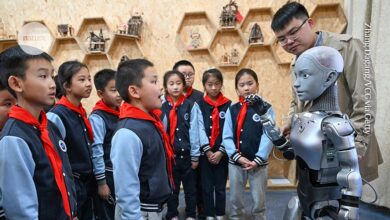



Only a small portion of patents owned by universities in China become commercial products.Credit: Xu Changliang/VCG via Getty
China’s intellectual-property regulator has been playing matchmaker — connecting researchers with patents to companies that can commercialize them.
Last month, the China National Intellectual Property Administration said that as a result of these introductions around 80,000 patents from universities and research institutes have been commercialised between 2023 to 2025.
The effort is part of the government’s desire to translate more research into products and services. China holds more than five million domestic-invention patents, but few are brought to market. In 2022, only 3.9% of university patents were commercialized, according to state media.
Since 2023, the agency says it has identified around 680,000 patents held by universities and research institutes that could be commercialized, and has connected the innovators with 460,000 companies that could bring the ideas to life.
Last month, the China National Intellectual Property Administration said that around 80,000 patents from universities (10.1%) and research institutes (17.2%) have been commercialised between 2023 to 2025, as a result of match making efforts.
Marina Zhang, who studies innovation with a focus on China at the University of Technology Sydney in Australia, thinks the match making will create lasting connections between academia and industry.
Robert Conn, who studies research and science philanthropy at the University of California, San Diego, says the approach is still new, so it is too early to tell how effective it will be in the long term. But he thinks it could work, because companies in China are often willing to adhere to government directives. “China’s system is top-down, with the state playing a central role in driving partnerships and setting directions,” he says.
The Chinese Ministry of Education is also exploring the use of artificial intelligence and big data to identify the potential value of university patents and possible applications, Zhou Dawang, an official with the ministry, told state media.
Commmercialization challenges
Patenting has been strongly encouraged by universities in the country and has been tied to career advancement for researchers, says Li Tang, a public-policy researcher at Fudan University in Shanghai, China, says that research. But at times, this “led to what we might call strategic patenting — in which patents are filed to meet evaluation criteria rather than to support downstream commercialization”, she says.
As a result, many patents have yet to demonstrate proof they will work, or are needed, says Zhang.
As well as the match making effort, the government has introduced incentives that reward the successful commercialization of research rather than the filing of patents.
Zhang says that the government is also taking steps to address systemic barriers that hold back research commercialization in China. These include unclear rules around who shares the profits of a patent and a shortage of technology-transfer professionals who help academics to translate patented technologies into commercial products, says Zhang.
Market forces
Source link