

.
Dani Rodrik recently
wrote an article entitled “The Post-Neoliberal
Consensus is here”. He argues that it comprises three elements:
-
the concentration of economic power has become excessive -
restoring dignity to people and regions that neoliberalism left
behind, which in particular involves providing good jobs -
The government has an active role to play in intervening in the
market economy
Such a ‘consensus’ is clearly not neoliberal. While some forms of
neoliberal theory do worry about excessive market power,
neoliberalism in practice does not. Equally neoliberalism celebrates
rather than worries about the growing wealth at the very top. While
neoliberalism may require a strong state, it is to protect an
‘unshackled’ and deregulated market economy, rather than directly
intervene in that economy. Of course Trump’s MAGA economy, if it
has any coherent logic at all, is also not neoliberal, because there
the state does intervene in the market economy (tariffs, immigration
controls, and even in some cases state holdings in major companies in
return for favours).
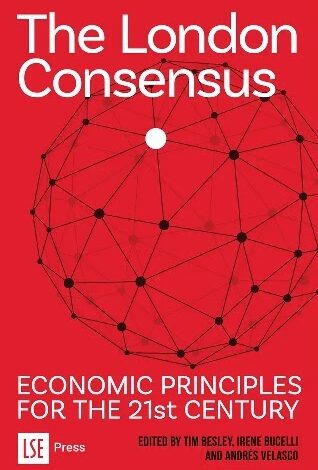
In October last year the LSE published
a book (see above) edited by Tim Besley & Andrés
Velasco (B&V) that attempts to define this new economic
consensus. In their introduction these authors outlined five core
principles.
-
The idea that the market does production and the government does any
required redistribution, while still often useful, no longer works
as a core principle. -
The need for an active innovation policy, both to increase growth
overall but also to make sure it is evenly spread geographically. -
Government is the insurer of last resort. This includes “There is
strong justification for an activist fiscal policy that goes far
beyond the Keynesian role.” -
Economics cannot be separated from politics. -
States need to be capable.
It is easy to relate these to Rodrik’s three points. Are both just
a reiteration of well known social democratic ideas? In some sense
clearly yes, but this is different from the social democracy
typically practiced in the UK in the 1960s or 70s, for example. In
particular, trade unions do not play a major role, and there is no
suggestion that state intervention should involve trying to shift the
Phillips curve. Nor is nationalisation seen as desirable for its own
sake.
Rodrik’s (1) can be seen as a specific example of B&V’s (4),
but I like the emphasis that Rodrik gives on this point. For example
A&V, like many economists, tend to discuss wealth taxes in terms
of revenue raised (uncertain because of international mobility etc)
rather than both fairness and, in particular, political power. The US
is the clearest example of the dangers that excessive wealth can
bring to politics, as the work of Martin Gilens (Affluence andInfluence: Economic Inequality and Political Power in America) and
others make clear. It is impossible to ignore this when you live
under a plutocratic dictatorship, but the UK is not immune to exactly
the same fate, and it would be foolish to think it is. [1]
This raises another question, which is whether discussions of a new
economic consensus is relevant at a time when liberal democracy is
fighting an existential battle with right wing populism at best, and
resurgent fascism at worst. Surely the best way of fighting this
battle is through economics that is popular, and whether it works
well has to be a secondary consideration.
The obvious response to this is that for liberal democratic
governments in power what works matters, because in part they will be
judged on how far what they have improved the welfare of the
electorate. Trying to assess what works matters. To put this point most bluntly, in many ways pursuing a
neoliberal conception of what economic policy should be has got us
into the position where the threat from right wing populism is so
grave, so it would be foolhardy indeed to carry on pursuing policies
based on that old consensus.
This new consensus is very relevant to the current UK government, for
example. I suspect it would sign up to points (2) and (3) on Rodrik’s
list, but in my view their implementation on both fronts has been
tentative in the extreme. Rodrick’s (1) is also the area where I am
most pessimistic, both in the UK and elsewhere. In the UK the power
of the populist press has gone unchallenged, as has GB news, as has
the BBC preferring to both sides events where the evidence is clear.
The government continues to use X rather than BlueSky, and appears to
have conceded that social media should be a propaganda weapon for the
populist right in the same way they have conceded it for the press.
Little has been done to curb the influence of money on politics, even
though this money (often from the US) clearly encourages and favours
the populist right, often in its most extreme form.
Can you reasonably argue that, in the battle to defeat right wing populism, it
is better to keep potentially sympathetic elements of the wealthy
elite onside by not pursuing Rodrik’s point (1)? Elements within
Labour in the UK and the Democrats in the US often act as if they believe there is a strong argument along these lines, but I would like
to see it clearly spelt out. The counterargument is very
strong. As long as concentrations of extreme wealth exist, and its
influence on politics is unchecked, then the battle between liberal
democracy and right wing populism is in danger of being never ending.
While it is important to lay out what the successor to neoliberalism
within liberal democracies should look like, there remains a tension
between these ideals of best practice and the battle between liberal
democracy and right wing populism, particularly when right wing
populism is in power. Whether all the the proposals put forward by
Zohran Mamdani in his victory in the New York City mayoral election,
or the platform of any other social liberal successfully fighting
right wing populists for that matter, would find favour with the
London Consensus may seem beside the point as long as they win.
As Martin Sandbu notes, the London Consensus is more of a handbook
than a left wing version of the Washington Consensus, and it would
take many more blog posts to cover its contents. That is something I
hope to do in future posts. But I think it and Rodrik’s article are
correct in identifying two ways in which neoliberalism is no longer
the intellectual force it once was. The first is a recognition that,
on political grounds alone, it is no longer politically feasible to ignore issues
of distribution on a regional or personal level in the pursuit of aggregate growth
or prosperity. The second is that markets fail in many ways, and a
capable state is vital in managing markets when this happens. This
was something most economists always knew, of course, and it is also
something that economists know rather a lot about.
[1] Like the US, the populist right in the UK has a core base that
brings it close to a majority. A mistake that is consistently made is
to equate the populist base in the UK with the Reform vote, but the
Conservative party under its current and likely future leader are
much the same. It was Boris Johnson who
greatly increased the influence of private wealth on
government decisions.
Source link