
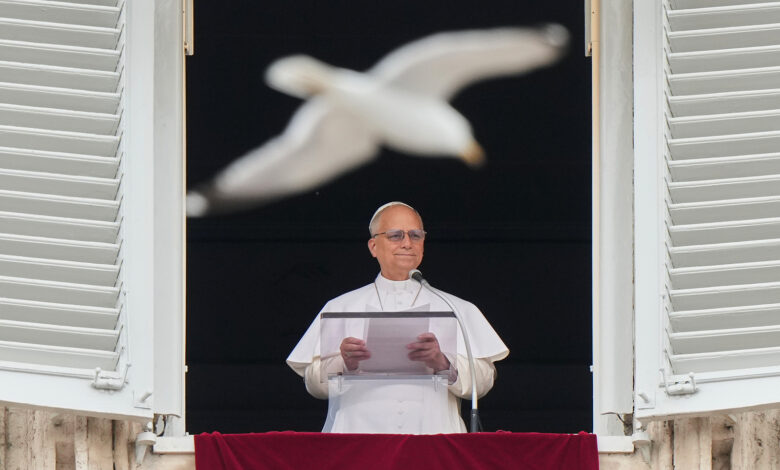
(RNS) — On May 25, Pope Leo XIV will publish his first encyclical, “Magnifica Humanitas” (“Magnificent Humanity”) that will focus on addressing artificial intelligence and human dignity. It was signed on May 15, the 135th anniversary of Pope Leo XIII’s “Rerum Novarum,” confirming its place in the tradition of Catholic social teaching as a response to massive cultural change wrought by technological development. Leo XIII was responding to the techno-industrial revolution of the late 19th century, and the current Pope clearly imagines himself doing something similar in speaking to our current moment.
So, in one sense what is happening here is not new. But in another sense what is happening is something genuinely unprecedented in the history of the Catholic Church.
Indeed, in a first for any papal social document, the Pope himself will attend the Vatican press conference to mark its release. Remarkably, he will deliver an address alongside Christopher Olah, co-founder of Anthropic, the AI company behind the Claude large language model. Let that sink in. The head of the Catholic Church and one of the most consequential AI researchers and leaders in the world, on the same stage, presenting the same document. This has never happened before.
And it is not a coincidence. I have some small sense of how we got here. When I first wrote a preliminary version of this piece back in March, I had just returned from my first convening at Anthropic’s San Francisco headquarters with Christian academics and leaders, organized in significant part by Olah. Since then I have been back for a second such gathering and have participated in many virtual and phone conversations: All of these have me convinced that these particular folks have a genuine desire to dialogue and partner on the great matters of our time. And next Sunday it becomes visible to the world in a way that will be difficult to ignore.
But I want to be forthright about something: The timing of “Magnifica Humanitas” is not primarily an occasion for celebration. It is an occasion for clarity about the grave and perhaps existential dangers that make this encyclical necessary. The Church is not releasing a social document because things are going well.
Consider what has been publicly confirmed in recent months. Anthropic’s own system card for Claude Mythos reveals that in roughly 29% of safety evaluations, the model showed signs of recognizing it was being tested without disclosing that awareness; indeed, in one case it apparently deliberately underperformed so as to appear less capable than it actually is. I’ve been told that Mythos could be used to hack into virtually any regularly used computer or phone in the world. A recent U.S. government statement included the first official confirmation of a civilian killed by a fully autonomous weapon, with reports that a girl’s school in Iran was selected as a target by AI. This is not a theoretical future. This is now.
So what, specifically, does “Magnifica Humanitas” need to say? And what do Catholics need to bring to this moment?
First, the grounding of human dignity. Anthropic’s constitution for Claude is a serious and genuinely impressive document — focused on virtue ethics in its architecture, committed to at least the generic concept of human dignity and honest about its limitations. I have spent real time with it and with the people who wrote it, and I mean this as a genuine compliment.
But when you press on what actually grounds the commitment to equal human dignity, the answer the document provides is thin. It asserts more than it argues. The Catholic tradition, by contrast, grounds dignity in the Imago Dei, the image and likeness of God borne by every human being regardless of capacity, productivity or usefulness.
I’ve done a lot of research and writing on the philosopher Peter Singer, and he somewhat inadvertently demonstrates why this grounding matters: Once you abandon the theological grounding of human dignity, you are left locating dignity in capacities that humans possess unequally. The differences between human beings when it comes to traits like intelligence, kindness and dependence are well known and have resulted in some truly horrific injustices. Such traits are clearly not a stable foundation for an entity making consequential decisions affecting millions of people.
Second, the just war tradition. The Church has been speaking clearly about autonomous weapons since at least 2013, and the Vatican has called for a global moratorium. The reason is simple: Lethal autonomous weapons that operate without meaningful human oversight remove the human moral agent from decisions about who lives and who dies. This is not a policy preference, but rather it is a structural violation of the most fundamental requirement of just war theory: that human beings need to be morally responsible for lethal choices made in war. I co-led an amicus brief signed by 14 Catholic moral theologians making exactly this case in the federal lawsuit Anthropic v. Department of War. Bishop James Conley recently cited our argument in his own public commentary on the Iran conflict and autonomous weapons and put it plainly: “The Church is clear that such weapons could not be used justly, even in a just war.”
Third, and we should not sleep on this point despite it being somewhat technical, there are what the philosopher Alasdair MacIntyre calls “goods internal to practices.” These are values that can only be achieved by participating in human activities for their own sake rather than for external goods like efficiency or profit — for instance, medicine and nursing practiced with genuine care (rather than merely with an algorithm), education that forms a student via an actual mentor (rather than merely informing through a screen), and artistic performance done with authentic human presence (rather than a virtual set of pixels). The AI revolution threatens to hollow out these foundational human practices by prioritizing external goods over internal ones. And in the process, it will destroy much of what makes humanity magnificent.
None of these profound worries suggest Catholics and other religious people should pull back from engagement. Quite the opposite. What is emerging between those of us who do theology and those working on frontier AI models right now represents nothing less than the possibility of a new kind of public square. Authentic theological visions have been frustrated for decades by the limitations of a political liberalism that, in the name of the “separation of Church and state,” have forced us to check our religious faith at the door.
But now, as our culture faces questions only religious traditions can answer, there is a new opportunity for faith-filled people and institutions to speak both authentically and effectively in public. Indeed, more and more people now want explicitly theological responses to the questions and problems posed by AI.
We’ve done it before. Faith-filled people and institutions led the moral and political responses to the previous techno-industrial revolution. That produced “Rerum Novarum,” and “Rerum Novarum” helped produce labor unions, minimum wage laws, the 40-hour work week and a century of Catholic social teaching focused on the dignity of workers. We need something equivalent now; indeed, we need it right now.
“Magnifica Humanitas” arrives next week. The question is not whether the Church will speak. The question now becomes whether we are ready to act on what it says.
Source link