
Nature
-

extreme wildfires are now more common
The frequency at which extreme fires occur around the world has more than doubled during the past two decades, according to an analysis of satellite data1. The trend is driven by the exponential growth of extreme fires across vast portions of Canada, the western United States and Russia, researchers say. The results provide the first solid evidence to support a…
Read More » -

How researchers and their managers can build an actionable career-development plan
A career-development plan can be a useful tool for researchers in both academia and industry.Credit: Getty Some scientists think of a career path as being set in stone, following a predictable trajectory. Typically, it starts with pursuing a PhD, followed by a postdoctoral position and — if the scientist is fortunate — obtaining a tenured position or perhaps moving away…
Read More » -
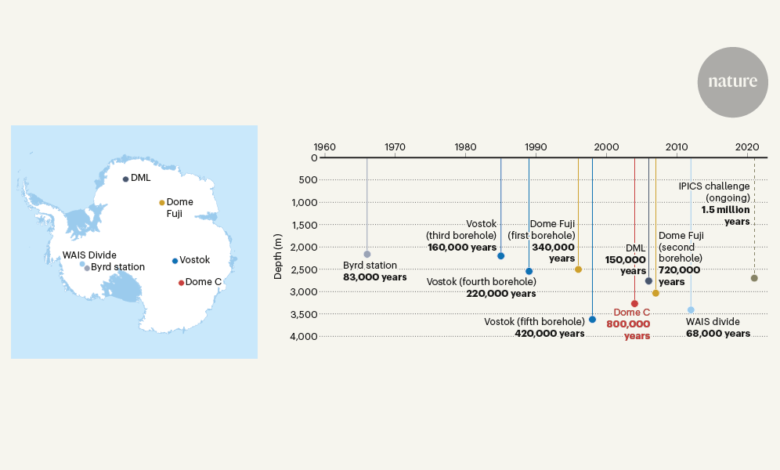
Two decades of deep ice cores from Antarctica
Nature, Published online: 10 June 2024; doi:10.1038/d41586-024-01507-5 In June 2004, the results of an ambitious Antarctic ice-drilling project brought insight into hundreds of thousands of years of climatic changes. The extraordinary sample still has much to offer climate research — even as its successor is being drilled. Source link
Read More » -
Physicists coax molecules into exotic quantum state — ending decades-long quest
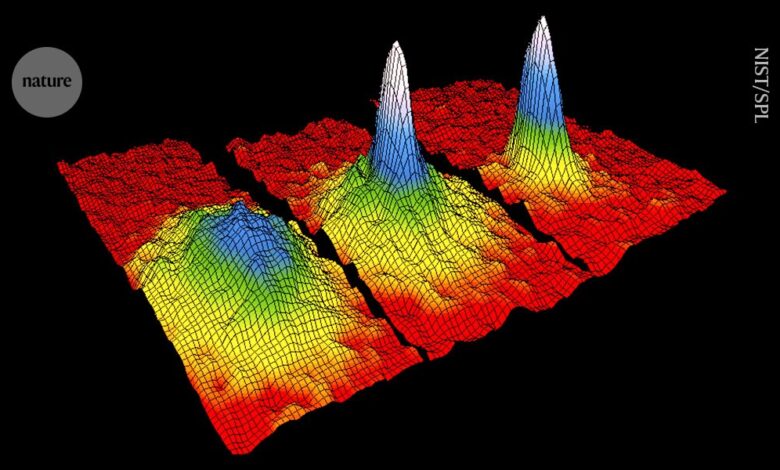
Velocity-distribution data for a gas of rubidium atoms before, during and after the appearance of a Bose–Einstein condensate. The peak forms as all the atoms occupy the lowest possible quantum energy state.Credit: National Institute of Standards and Technology/Science Photo Library A bizarre state of matter just got weirder — and more useful. Physicists have succeeded in cooling down molecules so…
Read More » -

Tackling ‘wicked’ problems calls for engineers with social responsibility
In the nineteenth century, steamboat explosions were common — until they weren’t.Credit: Universal History Archive/UIG/Getty Wicked Problems: How to Engineer a Better World Guru Madhavan W. W. Norton & Company (2024) Society relies on engineers to deliver almost everything it uses, from food and water to buildings, transport and telecommunications. But new technologies are often rushed into service, for market…
Read More » -

AI now beats humans at basic tasks — new benchmarks are needed, says major report
Artificial intelligence (AI) systems, such as the chatbot ChatGPT, have become so advanced that they now very nearly match or exceed human performance in tasks including reading comprehension, image classification and competition-level mathematics, according to a new report (see ‘Speedy advances’). Rapid progress in the development of these systems also means that many common benchmarks and tests for assessing them…
Read More » -

How two PhD students overcame the odds to snag tenure-track jobs
Researching the institutions you’re applying for can help you personalize your application.Credit: Getty Academic careers are meant to follow a set trajectory: PhD student, postdoctoral researcher, tenure-track job. But when we were thinking about what to do after our PhDs, we decided to skip the postdoc stage and go straight for tenure-track jobs owing to visa restrictions (Q.L., an international…
Read More » -

How synthetic biologists are building better biofactories
Scientists have used microorganisms to produce beneficial chemicals for decades. By providing the microbes with enzymes and metabolic pathways, researchers can coax cells to churn out everything from food additives to biofuels. One advantage of biomanufacturing is ecological: the processes are generally more environmentally friendly than are chemical manufacturing methods. But it’s expensive, mainly because cells won’t create something simply…
Read More » -

Weird new electron behaviour in stacked graphene thrills physicists
Electrons in stacked sheets of staggered graphene collectively act as though they have fractional charges at ultra-low temperatures.Credit: Ramon Andrade 3DCiencia/Science Photo Library Minneapolis, Minnesota Last May, a team led by physicists at the University of Washington in Seattle observed something peculiar. When the scientists ran an electrical current across two atom-thin sheets of molybdenum ditelluride (MoTe2), the electrons acted…
Read More » -

‘Bandit’ algorithms help chemists to discover generally applicable conditions for reactions
RESEARCH BRIEFINGS 18 March 2024 In organic chemistry, finding conditions that enable a broad range of compounds to undergo a particular type of reaction is highly desirable. However, conventional methods for doing so consume a lot of time and reagents. A machine-learning method has been developed that overcomes these problems. Source link
Read More »